Borders change, today and throughout history. Incorporating maps into the classroom encourages the students to view this for themselves and to begin to understand the myriad of ways that politics shapes geographical borders.
Read MoreDissertation Spotlight | Scribal Habits in Selected New Testament Manuscripts, Including those with Surviving Exemplars
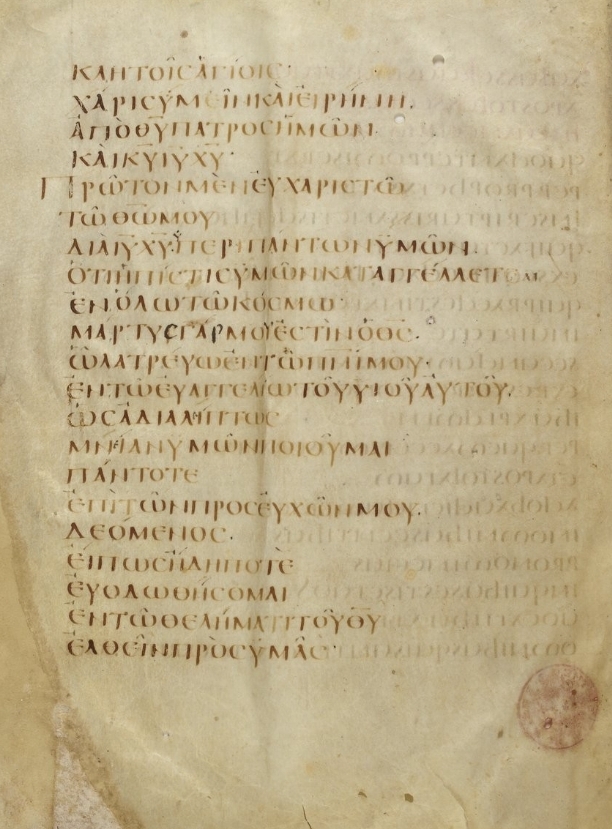
At the core of the dissertation, three chapters analyze the scribal habits of the copyists of various manuscripts.
Read MoreWeek in Review (8/24/18)
Late thirteenth-century restored “Deisis” (δέησις) Mosaic | Hagia Sophia, Istanbul | Image Source
This Week: Dunhuang manuscripts, calls for papers, Jewish foodways, ethnicity and the Peutinger Table, Shayna Sheinfeld on acting apocalypses – and more!
Read MorePerforming Apocalyptic Texts: Teaching the Eschatological Banquet from the Dead Sea Scrolls
The Wedding Banquet of Cupid and Psyche (1517) by Raphael. Villa Farnesina, Rome
“Performing the banquet shifted their analysis from the realm of the academic into the realm of something that is socially functional, assisting with student thinking about the ancient texts as representative of real people and their actions and beliefs.”
Read MoreBook Note | The Jewish Dietary Laws in the Ancient World
“To briefly sketch some of Rosenblum's findings, we see that Greek and Roman sources are often perplexed by or antagonistic to these laws, Hellenistic Jews justify the laws via allegory, reason, and revelation, Rabbinic sources only begin to provide justifications beyond revelation with the Amoraim, and later Christian sources return to allegory, while denying the literal adherence to these prohibitions.”
Read MoreWeek in Review (8/17/18)
Folio 1r from Hebrew Bible manuscript with Targum and commentaries | Bodleian Library Ms. Canon Or. 62, Oxford | Image Source
This Week: St Catherine’s Monastery and digital humanities, multilingualism along the Nile, antiquities trafficking, philosopher monks, ethical philology - and more!
Read MoreHarnessing Creativity in a Biblical Studies Classroom
If Esther had a Pinterest, what would she post on it? If Ruth had a Spotify playlist, what songs would she include? What if Susannah joined the #metoo movement?
Read MoreDissertation Spotlight | The Apophthegmata Patrum and the Greek Philosophical Tradition
Instead of only studying one particular practice, I have taken the monastic path of life as a whole, as proposed by the Apophthegmata Patrum, from conversion to advanced practice, and analyzed it light of the philosophical schools.
Read MoreWeek in Review (8/10/18)
Early Islamic-period mosaic with elaborate floral and Nilotic mosaics | Church of St. Stephen, Umm ar-Rasas | Image Source
This Week: Sara Ronis kicks off August Pedagogy Month, extra-biblical Psalms, rabbinic conversion, Syriac #openaccess, late antique bullying – and more!
Read MoreLamenting a Broken World: Student Learning Through Creative Writing
In this creative assignment, students were empowered to engage with the biblical text in new ways: they understood some of the ways that biblical texts can relate to the modern world and vice versa, they used their own creative voices, and they reflected critically on why we must develop awareness of moments of pain and trauma in the world around us.
Read MoreBook Note | The Rabbinic Conversion of Judaism
Lavee argues for reading the conflicting attitudes of renewal and rejection as reflecting a Babylonian attitude of ‘genealogical anxiety,’ marking the convert as reborn so as to disassociate them from their natal families while in so doing marking them as the ‘eternal other.’
Read MoreWeek in Review (8/2/18)
Trellis-carpet mosaic segment, with animals | Lod Mosaic, Israel | Image Source
This Week: Berzon’s response to Classifying Christians forum, apocrypha galore, Greco-Roman science, booksquashing and digital humanities, Lod mosaics – and more!
Read MoreOn Taxonomy and Classification: A Response
Throughout Classifying Christians, I proposed that Christian polemical ethnographers were operating both like physicists and anthropologists. In getting closer to the heretics—whether through personal or textual experience—the heresiologists actually made the terms of Christian culture both more and less clear.
Read MoreBook Note | Authority and Expertise in Ancient Scientific Culture
As a whole, the volume provides compelling evidence that various, interrelated “techniques of self-authorisation” were employed across (what the modern reader might categorize as) different scientific and technical genres, as a means not only for professionals to establish their credentials, but also for non-professionals to situate themselves in the social and political networks of the late Republic and the Roman Empire.
Read MoreWeek in Review (7/27/18)
Saint Ambrose and Augustine of Hippo | Altarpiece from Michael Wolgemut, Nuremberg c. 1495-98 | Image Source
This Week: Mira Balberg on Classifying Christians, heresy in Milan, Huqoq mosaics, scribality and the Dead Sea Scrolls, philology and provenance – and more!
Read MoreOne, Two, Many: Thoughts following Classifying Christians
In offering this innovative way of thinking of early Christian heresiology, Classifying Christians gives us an incisive (and indeed, troubling) outlook on contemporary academic practices and disciplines.
Read MoreBook Note | The Politics of Heresy in Ambrose of Milan
Drawing on this scholarly paradigm shift, Williams argues that understanding Christianity in the Milan of Ambrose’s time requires manoeuvring around an object, “heresy,” successfully conjured into existence by Ambrose’s rhetoric.
Read MoreWeek in Review (7/20/18)
The Aqedah (the “Binding of Isaac”) | Mosaic in a sixth-century Beth Alpha synagogue | Image Source
This Week: Forum on Berzon’s Classifying Christians continues, new book note, Dead Sea Scrolls, Eusebius meets digital humanities, the Moschus Ioudaios inscription – and more!
Read MoreEarly Christian Theological Anthropology and the Work of Classification: A Response to Todd S. Berzon
Todd Berzon’s Classifying Christians: Ethnography, Heresiology, and the Limits of Knowledge in Late Antiquity is a great book—sophisticated in its approach, challenging in the intricacy of its arguments, creative in its interdisciplinarity, and surprising in the ways in which it takes a genre that is easy to dismiss as trite and clichéd—that is, heresiology—and offers us a new lens with which to view it.
Read MoreBook Note | At the Temple Gates: The Religion of Freelance Experts in the Roman Empire
Wendt brings together, in accessible prose, a series of fascinating characters that have been neglected by many classical scholars, and who are largely absent in early Christian studies, under the etic category of “freelance religious expert.”
Read More