If Esther had a Pinterest, what would she post on it? If Ruth had a Spotify playlist, what songs would she include? What if Susannah joined the #metoo movement?
Read MoreDissertation Spotlight | The Apophthegmata Patrum and the Greek Philosophical Tradition
![Gherardo Starnina - Thebaid, ca. 1420, Tempera on wood (Wikimedia Commons) [Sometimes attributed to Fra Angelico]](https://images.squarespace-cdn.com/content/v1/5449167fe4b078c86b41f810/1534121418493-UZ3BXHO6ZL8M70BB8Q17/Angelico%2C_tebaide.jpg)
Gherardo Starnina - Thebaid, ca. 1420, Tempera on wood (Wikimedia Commons) [Sometimes attributed to Fra Angelico]
Gherardo Starnina - Thebaid, ca. 1420, Tempera on wood (Wikimedia Commons) [Sometimes attributed to Fra Angelico]
Instead of only studying one particular practice, I have taken the monastic path of life as a whole, as proposed by the Apophthegmata Patrum, from conversion to advanced practice, and analyzed it light of the philosophical schools.
Read MoreWeek in Review (8/10/18)

Early Islamic-period mosaic with elaborate floral and Nilotic mosaics | Church of St. Stephen, Umm ar-Rasas | Image Source
Early Islamic-period mosaic with elaborate floral and Nilotic mosaics | Church of St. Stephen, Umm ar-Rasas | Image Source
This Week: Sara Ronis kicks off August Pedagogy Month, extra-biblical Psalms, rabbinic conversion, Syriac #openaccess, late antique bullying – and more!
Read MoreLamenting a Broken World: Student Learning Through Creative Writing
![Southwest Texas McAllen Border Fence, Rio Grande Valley [ Photographer: Donna Burton ]](https://images.squarespace-cdn.com/content/v1/5449167fe4b078c86b41f810/1533738883693-XLDP3WL924ZNTV91Z2EM/32860951106_bc66460846_z.jpg)
Southwest Texas McAllen Border Fence, Rio Grande Valley [ Photographer: Donna Burton ]
Southwest Texas McAllen Border Fence, Rio Grande Valley [ Photographer: Donna Burton ]
In this creative assignment, students were empowered to engage with the biblical text in new ways: they understood some of the ways that biblical texts can relate to the modern world and vice versa, they used their own creative voices, and they reflected critically on why we must develop awareness of moments of pain and trauma in the world around us.
Read MoreBook Note | The Rabbinic Conversion of Judaism

Lavee argues for reading the conflicting attitudes of renewal and rejection as reflecting a Babylonian attitude of ‘genealogical anxiety,’ marking the convert as reborn so as to disassociate them from their natal families while in so doing marking them as the ‘eternal other.’
Read MoreWeek in Review (8/2/18)

Trellis-carpet mosaic segment, with animals | Lod Mosaic, Israel | Image Source
Trellis-carpet mosaic segment, with animals | Lod Mosaic, Israel | Image Source
This Week: Berzon’s response to Classifying Christians forum, apocrypha galore, Greco-Roman science, booksquashing and digital humanities, Lod mosaics – and more!
Read MoreOn Taxonomy and Classification: A Response

Stylized map of the world with Jerusalem at its center by Heinrich Bünting (1545-1696), woodcut, (Wikimedia Commons)
Stylized map of the world with Jerusalem at its center by Heinrich Bünting (1545-1696), woodcut, (Wikimedia Commons)
Throughout Classifying Christians, I proposed that Christian polemical ethnographers were operating both like physicists and anthropologists. In getting closer to the heretics—whether through personal or textual experience—the heresiologists actually made the terms of Christian culture both more and less clear.
Read MoreBook Note | Authority and Expertise in Ancient Scientific Culture

As a whole, the volume provides compelling evidence that various, interrelated “techniques of self-authorisation” were employed across (what the modern reader might categorize as) different scientific and technical genres, as a means not only for professionals to establish their credentials, but also for non-professionals to situate themselves in the social and political networks of the late Republic and the Roman Empire.
Read MoreWeek in Review (7/27/18)

Saint Ambrose and Augustine of Hippo | Altarpiece from Michael Wolgemut, Nuremberg c. 1495-98 | Image Source
Saint Ambrose and Augustine of Hippo | Altarpiece from Michael Wolgemut, Nuremberg c. 1495-98 | Image Source
This Week: Mira Balberg on Classifying Christians, heresy in Milan, Huqoq mosaics, scribality and the Dead Sea Scrolls, philology and provenance – and more!
Read MoreOne, Two, Many: Thoughts following Classifying Christians

Jerusalem on the Madaba Map ca. 570 (Wikimedia Commons)
Jerusalem on the Madaba Map ca. 570 (Wikimedia Commons)
In offering this innovative way of thinking of early Christian heresiology, Classifying Christians gives us an incisive (and indeed, troubling) outlook on contemporary academic practices and disciplines.
Read MoreBook Note | The Politics of Heresy in Ambrose of Milan

Gerard Seghers (1591-1651) - "The Four Doctors of the Western Church, Saint Ambrose" (Wikimedia Commons)
Gerard Seghers (1591-1651) - "The Four Doctors of the Western Church, Saint Ambrose" (Wikimedia Commons)
Drawing on this scholarly paradigm shift, Williams argues that understanding Christianity in the Milan of Ambrose’s time requires manoeuvring around an object, “heresy,” successfully conjured into existence by Ambrose’s rhetoric.
Read MoreWeek in Review (7/20/18)

The Aqedah (the “Binding of Isaac”) | Mosaic in a sixth-century Beth Alpha synagogue | Image Source
The Aqedah (the “Binding of Isaac”) | Mosaic in a sixth-century Beth Alpha synagogue | Image Source
This Week: Forum on Berzon’s Classifying Christians continues, new book note, Dead Sea Scrolls, Eusebius meets digital humanities, the Moschus Ioudaios inscription – and more!
Read MoreEarly Christian Theological Anthropology and the Work of Classification: A Response to Todd S. Berzon

Section of the Tabula Peutingeriana featuring Eastern Dacia and Thrace, 1-4th century CE. Facsimile edition by Conradi Millieri, 1887/1888 (Wikimedia Commons)
Section of the Tabula Peutingeriana featuring Eastern Dacia and Thrace, 1-4th century CE. Facsimile edition by Conradi Millieri, 1887/1888 (Wikimedia Commons)
Todd Berzon’s Classifying Christians: Ethnography, Heresiology, and the Limits of Knowledge in Late Antiquity is a great book—sophisticated in its approach, challenging in the intricacy of its arguments, creative in its interdisciplinarity, and surprising in the ways in which it takes a genre that is easy to dismiss as trite and clichéd—that is, heresiology—and offers us a new lens with which to view it.
Read MoreBook Note | At the Temple Gates: The Religion of Freelance Experts in the Roman Empire

Wendt brings together, in accessible prose, a series of fascinating characters that have been neglected by many classical scholars, and who are largely absent in early Christian studies, under the etic category of “freelance religious expert.”
Read MoreWeek in Review (13/7/2018)
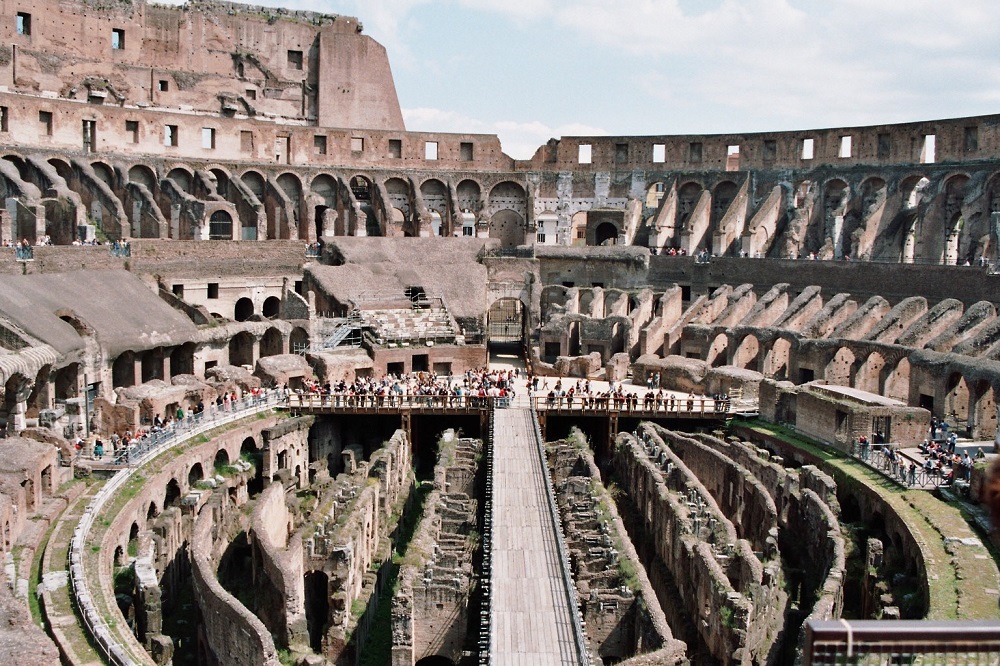
The Flavian Amphitheatre (Colosseum) | Rome, completed by Titus in 80CE | Image Source
The Flavian Amphitheatre (Colosseum) | Rome, completed by Titus in 80CE | Image Source
This Week: New Huqoq mosaic, Jews in Rome, Nag Hammadi codices, Marginalia Origin Forum bonanza, heresy, Sinai palimpsests – and more!
Read MoreClassifying Christians : An AJR Forum

Andreas Cellarius: Harmonia macrocosmica seu atlas universalis et novus, totius universi creati cosmographiam generalem, et novam exhibens. Plate 3. (Wikimedia Commons)
Andreas Cellarius: Harmonia macrocosmica seu atlas universalis et novus, totius universi creati cosmographiam generalem, et novam exhibens. Plate 3. (Wikimedia Commons)
Taking the ethnographic disposition as a starting point allows us to see how heresiologists acted in line with many other ancient writers, beyond or before Christianity, who also meant to know the world around them.
Read MoreClassifying Christians : An AJR Forum

In 2017, the Religious Worlds of Late Antiquity SBL section organized a review panel to discuss Todd Berzon's Classifying Christians: Ethnography, Heresiology, and the Limits of Knowledge in Late Antiquity. During the month of July, AJR will feature the panelists' responses.
Read MoreWeek in Review (6/29/2018)

Foot of the Constantine colossus | Courtyard of the Musei Capitolini, Rome | Image Source
Foot of the Constantine colossus | Courtyard of the Musei Capitolini, Rome | Image Source
This Week: Dead Sea Scrolls bonanza, big private money and biblical scholarship, the Alexamenos graffiti, Melania, Roman usurpers – and more!
Read MoreMade Tyrants by the Victory of Others

The colossal head of Constantine from the Capitoline Museum. This image of the emperor was recarved from a portrait of his fallen rival Maxentius, after the latter's death in battle against Constantine. (Wikimedia)
The colossal head of Constantine from the Capitoline Museum. This image of the emperor was recarved from a portrait of his fallen rival Maxentius, after the latter's death in battle against Constantine. (Wikimedia)
It would not be a mischaracterisation or an exaggeration to say that the late Roman state was a polity defined by civil war. Roman leaders at this time approached their rule ever cognizant of the fact that sooner or later, one of their subordinates could don the purple robe, stand before a provincial army, and be proclaimed emperor.
Read MoreBook Note | Melania: Early Christianity Through the Life of One Family

.jpg)


Melania, then, is a testament both to the impact the Melanias had on the nascent Christianity of the fourth century as well as the impact that Elizabeth Clark has had in shaping the study of that very world.
Read More