
Detail from the Lod Mosaic | Third-century mosaic from Lod, Israel | Image Details
This Week: Midrashic serpents, Megiddo excavation, the NEH, Roman animals, late antique books, new digital humanities projects – and more!
Read MoreDetail from the Lod Mosaic | Third-century mosaic from Lod, Israel | Image Details
Detail from the Lod Mosaic | Third-century mosaic from Lod, Israel | Image Details
This Week: Midrashic serpents, Megiddo excavation, the NEH, Roman animals, late antique books, new digital humanities projects – and more!
Read MoreAlbrecht Dürer - "The Fall of Man" (1504) | Image Source
Albrecht Dürer - "The Fall of Man" (1504) | Image Source
How do the rabbis conceptualize the biblical “cleverness” of the snake? How do such ideas map onto larger questions of human and animal embodiment?
Read MoreStang’s argument successfully and elegantly traces the motif of the divine double throughout these 2nd and 3rd century texts. He offers mostly close readings of these texts in ways that echo ancient Aristarchean criticism and “New Criticism,” and, as one can see in the introduction and the philosophical conclusion, he sees these texts in light of perennial questions of selfhood.
Read MoreMosaic representing Tabernacle with flanking menorah | Fifth-century synagogue, Tzipori | Image Source
Mosaic representing Tabernacle with flanking menorah | Fifth-century synagogue, Tzipori | Image Source
This Week: Mandaeans, the Temple, #InternationalWomensDay, maps and digital pedagogy, J.Z. Smith, Paul and Patristics – and more!
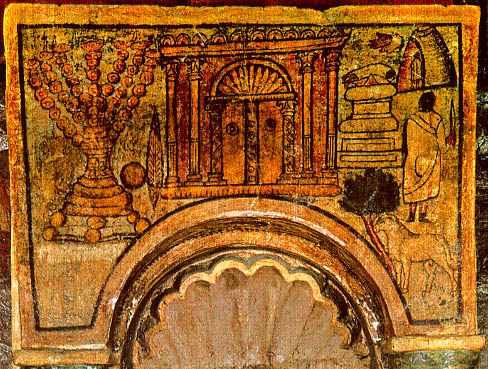
Read MoreThe Torah Shrine at Dura Europas via Wiki Commons
The Torah Shrine at Dura Europas via Wiki Commons
"Why does the Mishnah get so many historical details about the Second Temple period right?"
Read MoreVan Bladel’s book is thus not only a story of the Mandaean past, but a window into Sasanian Mesopotamia and the forging of “religious communities” beyond the “Greco-Roman” boundaries.
Read MoreMosaic section with Red Ship | Piazza Armerina, Sicily | Image Source
Mosaic section with Red Ship | Piazza Armerina, Sicily | Image Source
This Week: Late antique North Africa, Purim, keeping #digitalhumanities #openaccess, illegal papyrus trading, Apocryphal Arabic – and more!
Read More"Vandal" Horseman Mosaic from Carthage (ca. 450-550 CE) - Courtesy of the British Museum
"Vandal" Horseman Mosaic from Carthage (ca. 450-550 CE) - Courtesy of the British Museum
My book aims in part to connect debates between Nicenes and Homoians in Vandal Africa—and across the post-imperial West—to those wider developments in the historiography of late ancient Christianity from which they have been peculiarly absent.
Read MoreThe subject of Moss’s monograph, a revision of his Yale dissertation, is Severus’s theological, political, liturgical, and cultural contestations with fellow anti-Chalcedonians inclined to give up on the imperial church.
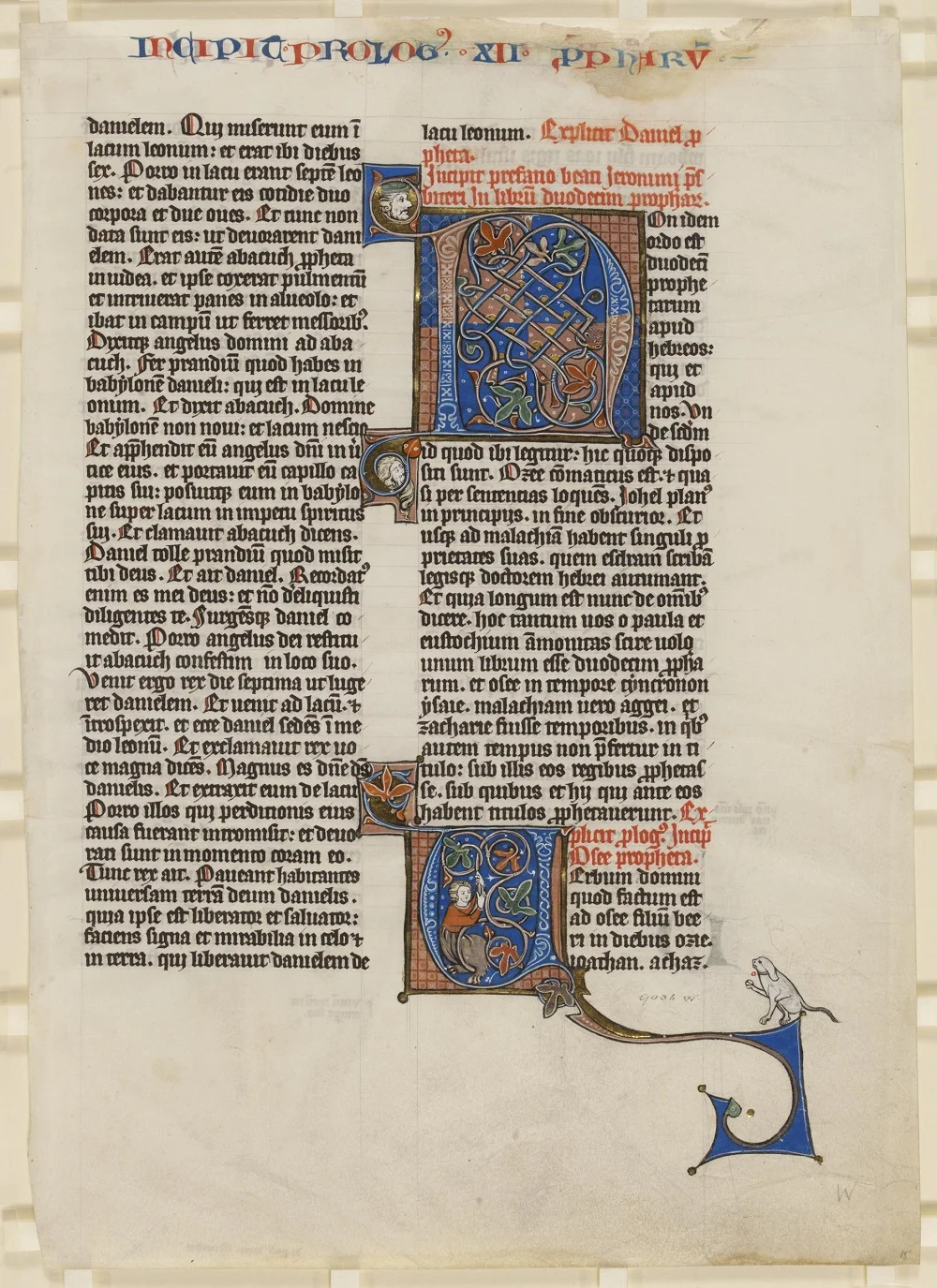
Read MoreIlluminated leaf from the Book of Hosea | From a Bible made for the Teutonic Knights at Nieuwe Biesen, ca. 1300 | Image Source
Illuminated leaf from the Book of Hosea | From a Bible made for the Teutonic Knights at Nieuwe Biesen, ca. 1300 | Image Source
This Week: Huge papyri databases, debate over “seal of Isaiah,” #digitalhumanities galore, unstable masculinity, rabbinic ethnography – and more!
Read MoreJohn Tenniel (1865).
John Tenniel (1865).
Are there patterns among these descriptive detours, the rabbit-holes of the rabbinic imagination? Do they point to consistent interests? Retrace stock motifs and techniques? How can we map their interconnections, and how are they linked to normative projects–broadly defined–at the nerve-center of this rabbinic canon?
Read MoreHer innovation is bringing the male prophetic body, not just prophetic words, under consideration.
Read MoreVirgin Mary and child | Apse mosaic, Santa Maria Assunta, Venice | Image Source
Virgin Mary and child | Apse mosaic, Santa Maria Assunta, Venice | Image Source
This Week: On anti-Jewishness, #digitalhumanities, palaeography online, photo archives, lullabies, Second Temple Torah – and more!
Read MoreSaint Augustine (Wikimedia Commons)
Saint Augustine (Wikimedia Commons)
To call a gentile Christian a “Jew” was likewise to accuse him of being un-Christian, indeed of being anti-Christian. The heretical Christian “Jew” – whatever current Christian doctrinal enemy that might be – was thereby identified with the scriptural enemies of Paul, of Jesus, and of God.
Read MoreOriginally delivered as a series of lectures at Berkley in 2013, Collins seeks to synthesize recent scholarly debates about the nature of ancient Jewish (or Judean) identity. In particular, Collins examines the role the Torah, or Law of Moses, played in the formation of a distinct religious and cultural way of life.
Read MoreDetail of mother feeding child | Sarcophagus of Marcus Cornelius Statius, c.150CE, currently in the collection of the Louvre | Image Source
Detail of mother feeding child | Sarcophagus of Marcus Cornelius Statius, c.150CE, currently in the collection of the Louvre | Image Source
This Week: Fragments, #pedagogy, ancient medicine, visualizing Jesus, talking race – and more!
Read MoreFragmentary Colossal Head of a Youth, Greek, Hellenistic Period, 2nd century B.C.E., Marble
Berlin, Pergamonmuseum, Staatliche Museen zu Berlin (AvP VII 283) / Antikensammlung
Fragmentary Colossal Head of a Youth, Greek, Hellenistic Period, 2nd century B.C.E., Marble
Berlin, Pergamonmuseum, Staatliche Museen zu Berlin (AvP VII 283) / Antikensammlung
Whose voices from the past have been preserved, whose voices have been lost, and what is at stake, ethically and methodologically, for whose voices, past and present, we choose to hear today?
Read MoreRoman marble plaque showing parturition scene, 400BCE - 300CE (Ostia, Italy) - UK Science Museum
Roman marble plaque showing parturition scene, 400BCE - 300CE (Ostia, Italy) - UK Science Museum
Lehmhaus’s talk pointed to exciting possibilities for future scholarship which grapple with how to fully understand the multipolar functions, within rabbinic literature and beyond it, of discrete bits of scientific or medical data embedded in rabbinic texts.
Read MoreMosaic inscription from Rehov Synagogue | Beth Shean Valley, C6-C7CE | Image Source
Mosaic inscription from Rehov Synagogue | Beth Shean Valley, C6-C7CE | Image Source
This Week: #digitalhumanities, Museum of the Bible, magic and apotropaic amulets, classification and classics, podcasts – and more!
Read MorePhoto courtesy of author
Photo courtesy of author
Perhaps we should trip in the same way on that word “museum.” We should attend to the stories museums and colonies tell about themselves; we should be cognizant of their designs on the body.
Read More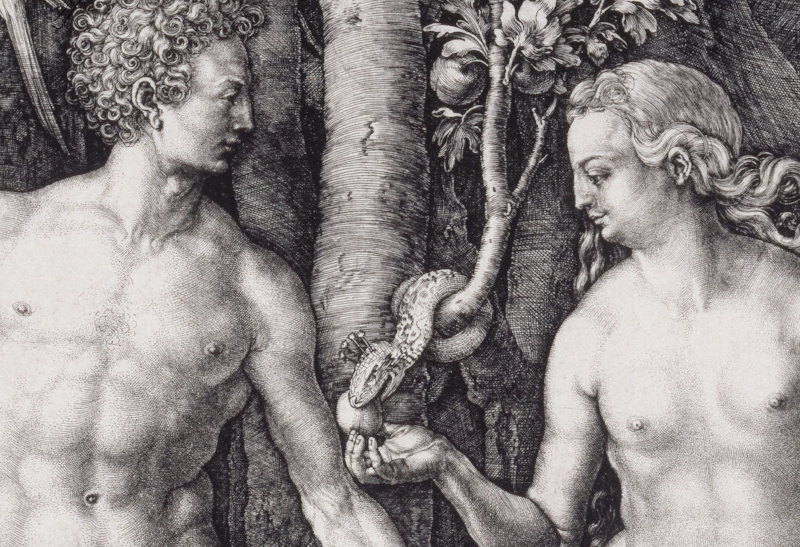






.jpg)

_2.jpg)
_-_Venice_2016_(2).jpg)

