Saint Paul Writing his Epistles by Valentin de Boulogne (ca. 1618 - 1620) Wikimedia Commons
"Reading Thiessen and Kaden synoptically thus fosters debate over how best to relate globalization studies and biblical studies."
Read MoreSaint Paul Writing his Epistles by Valentin de Boulogne (ca. 1618 - 1620) Wikimedia Commons
Saint Paul Writing his Epistles by Valentin de Boulogne (ca. 1618 - 1620) Wikimedia Commons
"Reading Thiessen and Kaden synoptically thus fosters debate over how best to relate globalization studies and biblical studies."
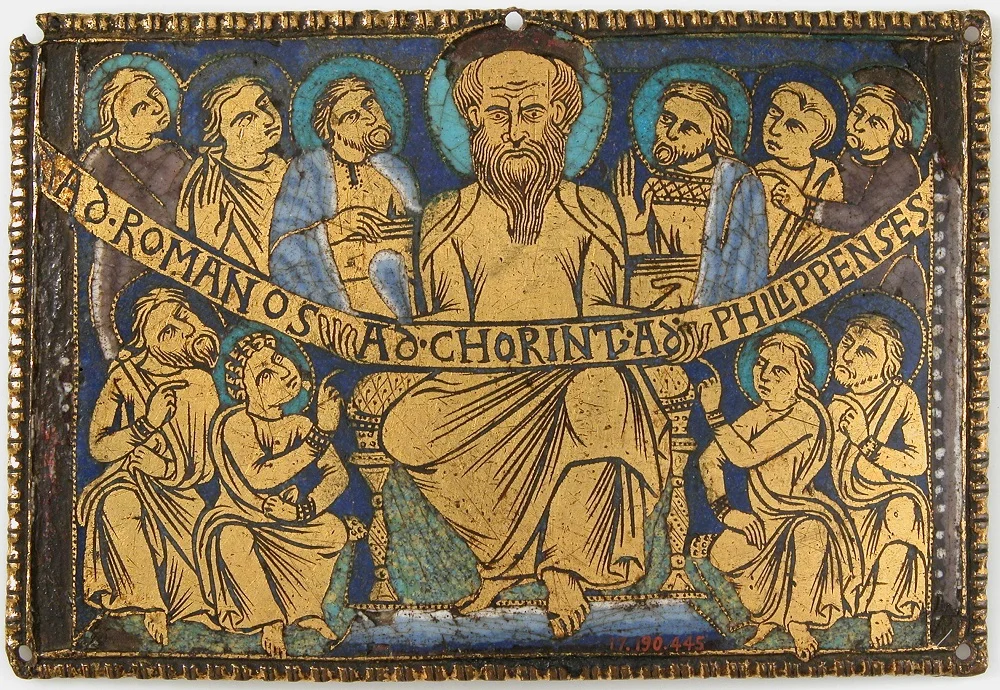
Read MoreEnamel plaque, St Paul and his Disciples | English(?), ca. 1160-80 | On display in the Metropolitan Museum of Art, New York
Enamel plaque, St Paul and his Disciples | English(?), ca. 1160-80 | On display in the Metropolitan Museum of Art, New York
This Week: Digital Palmyra, maps on shields, the Temple Mount, holy women, micrography, ancient letters about wine – and much more!
Read More"While we cannot say that the text reflects actual debates that proponents of a virginal life were having, we can certainly point to it as an example of debates that they imagined they could or would have had similar confrontations. A close engagement with The Life of Saint Helia might therefore provide some insight into how the community—whether it be Priscillianist, Jeromian, or otherwise—attempted to locate themselves within the tradition of Scripture and its interpretation."
Read MoreGold leaf and glass bowl base, with Menorah, Shofar, and Torah Ark | Roman, ca. 300-350, currently on display in the Metropolitan Museum, New York.
Gold leaf and glass bowl base, with Menorah, Shofar, and Torah Ark | Roman, ca. 300-350, currently on display in the Metropolitan Museum, New York.
This Week: Dunhuang online, new journals, ancient Jewish sarcophagi, Chinese Christianity, intellectual history – and much more!
Read MoreSeasons sarcophagus with menorah in the clipeus. From the Vigna Randani catacombs, Rome. Musei Nazionale Romano, Terme di Diocleziano, Inv. No. 67611. (Photo: Author).
Seasons sarcophagus with menorah in the clipeus. From the Vigna Randani catacombs, Rome. Musei Nazionale Romano, Terme di Diocleziano, Inv. No. 67611. (Photo: Author).
"The use of sarcophagus burial by Jewish patrons was a highly variable mode of cultural interaction, representing an ongoing negotiation of Jewishness by different individuals from different communities in the context of enduring cultural exchange."
Read MoreZachary Domach with an overview of Wilson's translation and commentary of The Sentences of Sextus: "his commentary exemplifies how a study of Sextus—and wisdom literature in general—reveals the intertwining of Greek, Jewish, and Christian thought as “actual ‘life’” in Late Antiquity."
Read MoreLouis Armstrong, Library of Congress's Prints and Photographs division under the digital ID cph.3c27236.
Louis Armstrong, Library of Congress's Prints and Photographs division under the digital ID cph.3c27236.
Dr. Michael Swartz and Dr. Michael Satlow share a book that was an "unexpected influence" upon their academic work.
Read MoreMary and the Disciples at Pentecost | Rabbula Gospels, fol. 14b | Image credit: Everett Ferguson photo collection
Mary and the Disciples at Pentecost | Rabbula Gospels, fol. 14b | Image credit: Everett Ferguson photo collection
This Week: Heresy, Mithras, a Herodian fortress, race and polychromy, "#digitalhumanities galore, a double book note - and more!
Read More"One of Berzon’s constant reminders is that powerful ideologies and strategies of representation often strive to hide their own seams and points of tension, but that it is in the process of highlighting these very points of tension that they find themselves at their most reproducible but also at their most frail. The late ancient heresiologists cultivated strong rhetorics of exceptionality and mastery—the heresy hunter excelled at making discoveries and at flaunting erudition—but also rehearsed a discourse of fear of contagion, vulnerability, and epistemic overload."
Read More"With one eye on Barr’s critiques and another on Guy Deutscher’s more recent linguistic work, she avoids a lexical-based approach and posits that a better method for identifying reflective thought on time is to appeal to an author’s syntax and “habital use” of language—ways by which the author directs the reader to concentrate on certain aspects of the world—and an author’s ability to do this transcends the sum of her lexical stock.
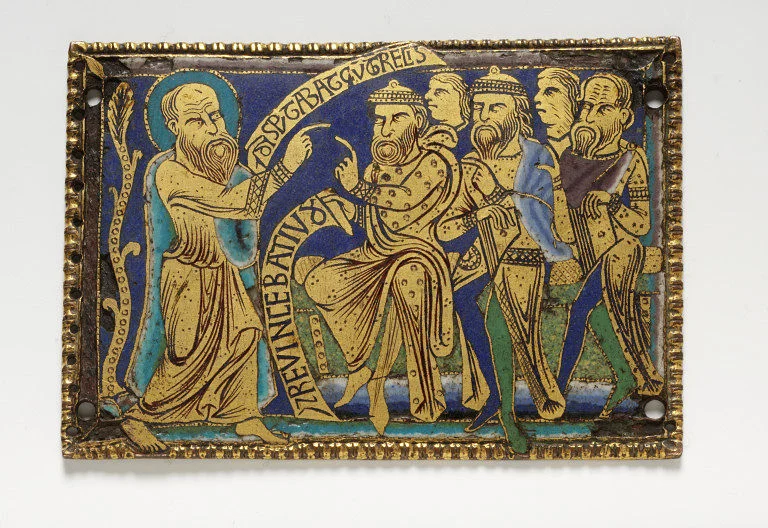
Read MoreSt. Paul disputing with the Jews and the Greeks | Enamel gilding, copper plaque, made in England ca. 1170-80 (probable) | London, Victoria and Albert Museum 223-1874
St. Paul disputing with the Jews and the Greeks | Enamel gilding, copper plaque, made in England ca. 1170-80 (probable) | London, Victoria and Albert Museum 223-1874
This Week: Jewish identity, Open Access wonders, frescoes, endangered Ethiopian archives, material religion - and much more!
Read More"Marx-Wolf demonstrates that these Platonist thinkers were closely connected despite the fact that one is a Christian and the other three are non-Christian. To this end, she reads these Platonists not in terms of different social or religious affiliations, but in terms of a shared paideia (2-3). She contends that this common formation explains elements of their thought that might otherwise be “surprising” such as Porphyry’s rejection of animal sacrifice."
Read MoreJerusalem, from the Madaba Map | Plate from Piccirillo and Alliata (ed.), The Madaba Map Centenary, 1897-1997: Travelling through the Byzantine Umayyad Period (1999)
Jerusalem, from the Madaba Map | Plate from Piccirillo and Alliata (ed.), The Madaba Map Centenary, 1897-1997: Travelling through the Byzantine Umayyad Period (1999)
This Week: Dura Europos, Melania, working-class women, anti-Semitism, patristics, Epiphanius the twit and much more!
Read More"Stroumsa makes a subtle move here, however: rather than suggesting, as many before him have, that there was a transition from cult-centered religion to book-centered religion, he argues that book becomes cult."
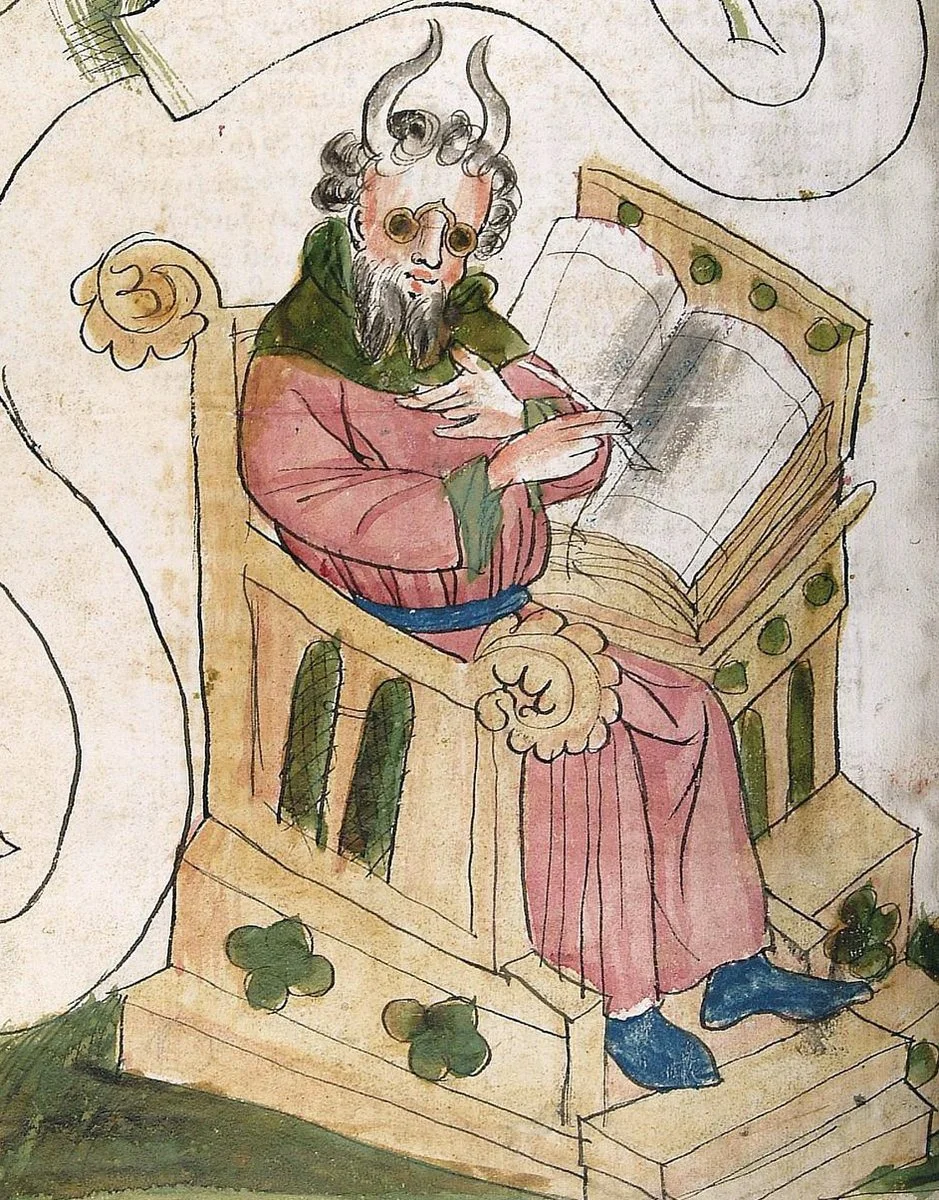
Read MoreMoses in the scriptorium | Bible, Hagenau ca. 1441-1449 (Universitätsbibliothek Heidelberg, Cod. Pal. Germ. 19, fol. 141v)
Moses in the scriptorium | Bible, Hagenau ca. 1441-1449 (Universitätsbibliothek Heidelberg, Cod. Pal. Germ. 19, fol. 141v)
This Week: Archaeological experiments, ancient brain science, the meaning of “Jew,” ancient library organization, and more!
Read Moreff. 490V from the Trilingual Compendium of Texts (England, 14th c). Reproduced by kind permission of the Syndics of Cambridge University Library
ff. 490V from the Trilingual Compendium of Texts (England, 14th c). Reproduced by kind permission of the Syndics of Cambridge University Library
"The 'cerebral subject' might be the product of neuroscience and early modern philosophy, but its roots go much further back to antiquity, in the encounter between emergent Christian theories of the soul and entrenched medical understandings of the brain."
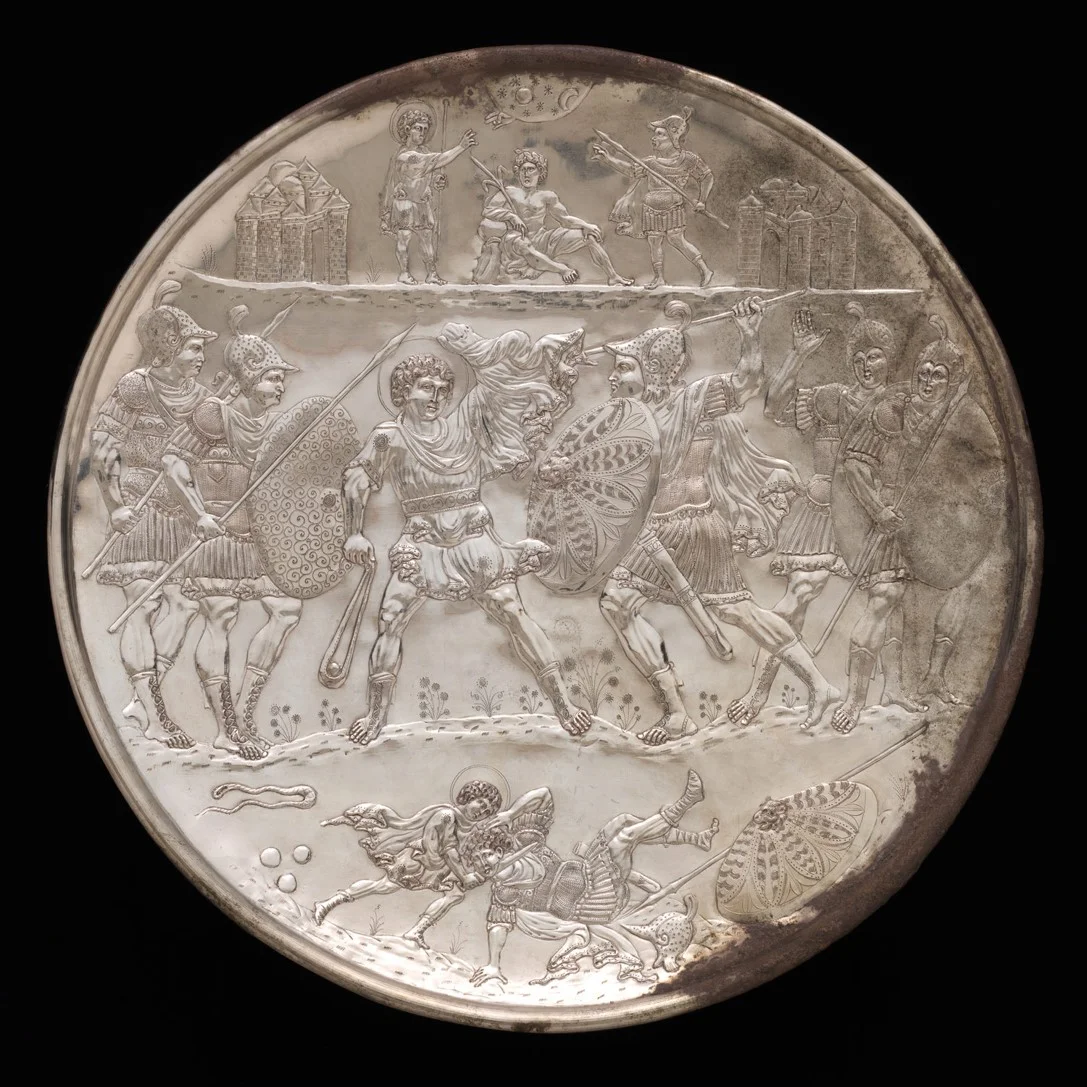
Read MoreDavid and Goliath, Silver Plate from the Karavas hoard (Constantinople, 629-30CE) | Currently held in the Met Museum, NY | http://www.metmuseum.org/toah/works-of-art/17.190.396/
David and Goliath, Silver Plate from the Karavas hoard (Constantinople, 629-30CE) | Currently held in the Met Museum, NY | http://www.metmuseum.org/toah/works-of-art/17.190.396/
AJR's Week in Review features Jerash, Genizah medicine, tasty Nabataean dates, Armenian, Silk Road studies, alchemy, rappers doing Deuteronomy, and more!
Read More"Of course, explaining the rise of an Islamic empire as a response to decline in the Roman and Sasanian empires is not a novel approach. Hoyland departs in analyzing the Arabs as a “peripheral people” that had specific political ties to both the Roman and Sasanian empire and thus gained a broader perspective for their own political ambitions."
Read More