The German National Library, courtesy of theeuropeanlibrary.org
Blossom Stefaniw’s contribution to the Textual Objects and Material Philology Panel from SBL 2018.
Read MoreThe German National Library, courtesy of theeuropeanlibrary.org
The German National Library, courtesy of theeuropeanlibrary.org
Blossom Stefaniw’s contribution to the Textual Objects and Material Philology Panel from SBL 2018.
Read MoreJanet Spittler’s contribution to the Textual Objects and Material Philology Panel from SBL 2018.
Read MoreMonika Amsler. “Effective Combinations of Words and Things: The Babylonian Talmud Gittin 67b-70b and the Literary Standards of Late Antiquity,” PhD Dissertation, University of Zurich, Switzerland, 2018.
Read MoreDr. Catherine Hezser introduces her book Bild und Kontext: Jüdische und christliche Ikonographie der Spätantike: “I examine exemplary biblical, mythological, and symbolic images in the context of Jewish, Christian, and Graeco-Roman literary sources to determine their possible uses and meanings within the multi-cultural realms of late antique society. I argue that the images were carefully chosen to engage in an ongoing visual discourse within the public sphere.”
Read MoreMy book is about reading as world-building, because reading with a grammarian in antiquity meant reading in a pool of fragmentation, displacement, and homogenization to re-arrange time and re-align filiation.
Read More“One plus one plus one cannot equal one. Neither does the Old Testament equal the Tanakh. They are not one.”
Read MoreLion, detail of mosaic, Mount Nebo (Mosaics of Jordan, fig. 219 on p. 169). Chapel of the Priest John at Khirbat-al-Mukhayyat, Jordan 565 CE. Courtesy of the Franciscan Custody of the Holy Land, Mount Nebo, and the American Center of Oriental Research, Amman. Permission obtained by author.
Lion, detail of mosaic, Mount Nebo (Mosaics of Jordan, fig. 219 on p. 169). Chapel of the Priest John at Khirbat-al-Mukhayyat, Jordan 565 CE. Courtesy of the Franciscan Custody of the Holy Land, Mount Nebo, and the American Center of Oriental Research, Amman. Permission obtained by author.
The intellectual climate had changed, and I saw that I needed to situate my work as an historian in contemporary animal theorizing in order to be responsive to the interpretive richness of this new cultural moment in scholarship and to develop a vocabulary that might enable a reading “otherwise” of ancient Christian texts that feature animals.
Read MoreKing Ahashverush and the maidens, Shahin, Ardashir-nameh, Persia, 2nd half of the 17th century (Berlin, Staatbibliothek Preussischer Kulturbesitz)
King Ahashverush and the maidens, Shahin, Ardashir-nameh, Persia, 2nd half of the 17th century (Berlin, Staatbibliothek Preussischer Kulturbesitz)
“There is evidence that Persian Muslims and Jews shared notions about the story that united them on the one hand and distinguished them from their coreligionists elsewhere on the other.”
Read More"Do Christians have to marry in churches? Historically, many Christian theologians have said “yes.” But they haven’t always. It wasn’t until the tenth century, for example, that the Byzantine emperor made a church ceremony a required element of marriage for Orthodox Christians. Nor was Constantinople at the forefront of the matter.”
Read MoreJoshua passing the River Jordan with the Ark of the Covenant by Benjamin West, 1800
Joshua passing the River Jordan with the Ark of the Covenant by Benjamin West, 1800
Liane M. Feldman, “Story and Sacrifice: Ritual, Narrative, and the Priestly Source,” PhD Dissertation, University of Chicago, 2018.
Read MoreThe Apostle Paul in St. Sophia of Kyiv via Wiki Commons.
The Apostle Paul in St. Sophia of Kyiv via Wiki Commons.
Cavan Concannon responds to Adi Ophir and Ishay Rosen-Zvi’s book, Goy: Israel’s Multiple Others and the Birth of the Gentile in the AJR review forum.
Read More“Moses receiving the law” in the Basilica of San Vitale is a church in Ravenna, Italy,
“Moses receiving the law” in the Basilica of San Vitale is a church in Ravenna, Italy,
Christine Hayes responds to Adi Ophir and Ishay Rosen-Zvi’s book, Goy: Israel’s Multiple Others and the Birth of the Gentile in the AJR review forum.
Read MoreIsaac, Jacob, and Esau at Cathedral of Monreale, Italy via Wiki Commons.
Isaac, Jacob, and Esau at Cathedral of Monreale, Italy via Wiki Commons.
Yair Furstenberg responds to Adi Ophir and Ishay Rosen-Zvi’s book, Goy: Israel’s Multiple Others and the Birth of the Gentile in the AJR review forum.
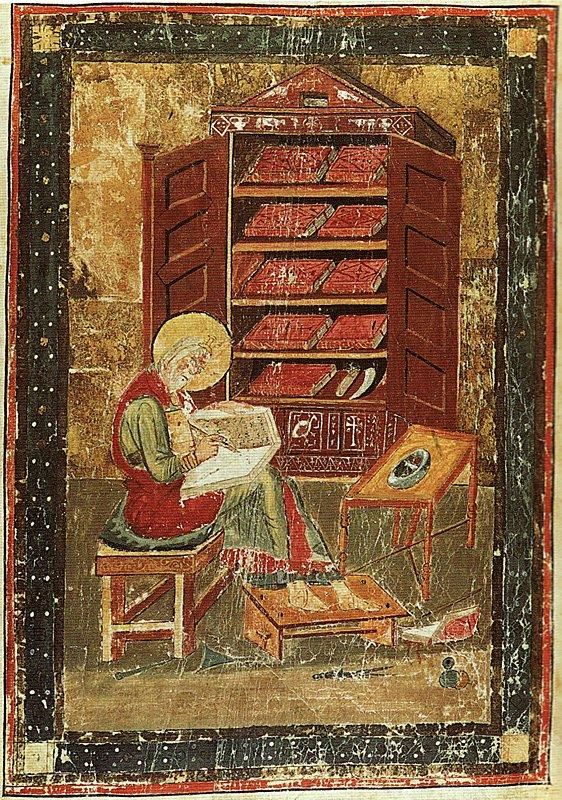
Read MorePortrait of Ezra, from folio 5r of The Codex Amiatinus. © Biblioteca Medicea Laurenziana
Portrait of Ezra, from folio 5r of The Codex Amiatinus. © Biblioteca Medicea Laurenziana
Cynthia Baker responds to Adi Ophir and Ishay Rosen-Zvi’s book, Goy: Israel’s Multiple Others and the Birth of the Gentile in the AJR review forum.
Read MoreThe AJR review forum of Adi Ophir and Ishay Rosen-Zvi’s book, Goy: Israel’s Multiple Others and the Birth of the Gentile. With responses from Cynthia Baker, Yair Furstenberg, Christine Hayes, and Cavan Concannon.
Read MoreAdi Ophir and Ishay Rosen-Zvi open the AJR review forum of their book, Goy: Israel’s Multiple Others and the Birth of the Gentile.
Read MorePapers from the 2018 Society of Biblical Literature’s review panel on Maia Kotrosits’s Rethinking Early Christian Identity: Affect, Violence, and Belonging (Fortress, 2015).
Read MoreThe Figure of Job - Folio 46r from the Syriac Bible of Paris (Bibliothèque Nationale, MS syr. 341) Image courtesy of Wikimedia Commons
The Figure of Job - Folio 46r from the Syriac Bible of Paris (Bibliothèque Nationale, MS syr. 341) Image courtesy of Wikimedia Commons
Nevertheless, I characterize the book as more protean. It resists reductive readings, always offering a counter-text to any interpretation (including the one in this essay.)
Read MoreChrist healing the leper (Wikimedia Commons)
Christ healing the leper (Wikimedia Commons)
I argue one must take into account not only what magic is said to be, but also what magicians do. There is a reason, after all, that these practices are the ones against which Apuleius was compelled to mount his defense.
Read MoreMaia Kotrosits responds to the review forum on Rethinking Early Christian Identity: Affect, Violence, and Belonging (Fortress, 2015).
Read More