Codex Claromontanus: Romans 1:7-1 (Image courtesy of the Bibliothèque nationale de France)
At the core of the dissertation, three chapters analyze the scribal habits of the copyists of various manuscripts.
Read MoreCodex Claromontanus: Romans 1:7-1 (Image courtesy of the Bibliothèque nationale de France)
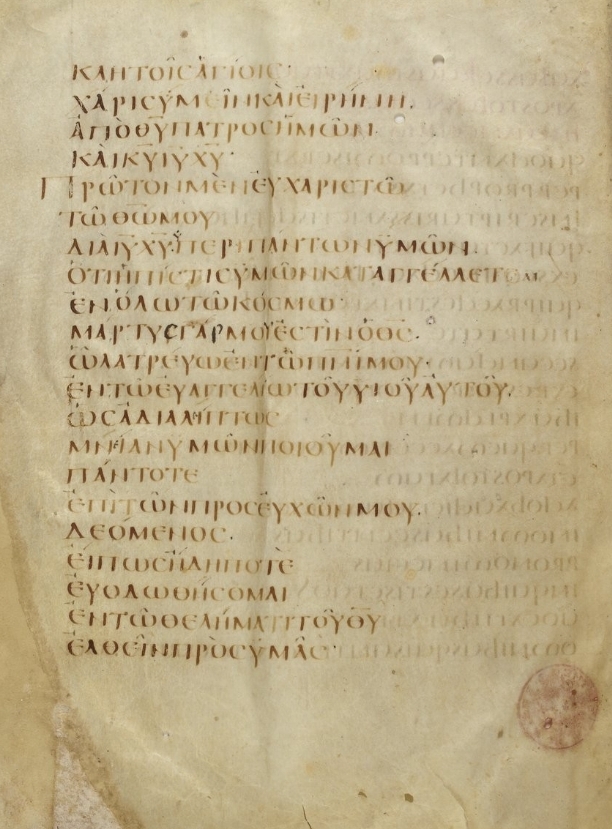
Codex Claromontanus: Romans 1:7-1 (Image courtesy of the Bibliothèque nationale de France)
At the core of the dissertation, three chapters analyze the scribal habits of the copyists of various manuscripts.
Read MoreThe Wedding Banquet of Cupid and Psyche (1517) by Raphael. Villa Farnesina, Rome
The Wedding Banquet of Cupid and Psyche (1517) by Raphael. Villa Farnesina, Rome
“Performing the banquet shifted their analysis from the realm of the academic into the realm of something that is socially functional, assisting with student thinking about the ancient texts as representative of real people and their actions and beliefs.”
Read MoreIf Esther had a Pinterest, what would she post on it? If Ruth had a Spotify playlist, what songs would she include? What if Susannah joined the #metoo movement?
Read MoreGherardo Starnina - Thebaid, ca. 1420, Tempera on wood (Wikimedia Commons) [Sometimes attributed to Fra Angelico]
Gherardo Starnina - Thebaid, ca. 1420, Tempera on wood (Wikimedia Commons) [Sometimes attributed to Fra Angelico]
Instead of only studying one particular practice, I have taken the monastic path of life as a whole, as proposed by the Apophthegmata Patrum, from conversion to advanced practice, and analyzed it light of the philosophical schools.
Read MoreSouthwest Texas McAllen Border Fence, Rio Grande Valley [ Photographer: Donna Burton ]
Southwest Texas McAllen Border Fence, Rio Grande Valley [ Photographer: Donna Burton ]
In this creative assignment, students were empowered to engage with the biblical text in new ways: they understood some of the ways that biblical texts can relate to the modern world and vice versa, they used their own creative voices, and they reflected critically on why we must develop awareness of moments of pain and trauma in the world around us.
Read MoreStylized map of the world with Jerusalem at its center by Heinrich Bünting (1545-1696), woodcut, (Wikimedia Commons)
Stylized map of the world with Jerusalem at its center by Heinrich Bünting (1545-1696), woodcut, (Wikimedia Commons)
Throughout Classifying Christians, I proposed that Christian polemical ethnographers were operating both like physicists and anthropologists. In getting closer to the heretics—whether through personal or textual experience—the heresiologists actually made the terms of Christian culture both more and less clear.
Read MoreJerusalem on the Madaba Map ca. 570 (Wikimedia Commons)
Jerusalem on the Madaba Map ca. 570 (Wikimedia Commons)
In offering this innovative way of thinking of early Christian heresiology, Classifying Christians gives us an incisive (and indeed, troubling) outlook on contemporary academic practices and disciplines.
Read MoreSection of the Tabula Peutingeriana featuring Eastern Dacia and Thrace, 1-4th century CE. Facsimile edition by Conradi Millieri, 1887/1888 (Wikimedia Commons)
Section of the Tabula Peutingeriana featuring Eastern Dacia and Thrace, 1-4th century CE. Facsimile edition by Conradi Millieri, 1887/1888 (Wikimedia Commons)
Todd Berzon’s Classifying Christians: Ethnography, Heresiology, and the Limits of Knowledge in Late Antiquity is a great book—sophisticated in its approach, challenging in the intricacy of its arguments, creative in its interdisciplinarity, and surprising in the ways in which it takes a genre that is easy to dismiss as trite and clichéd—that is, heresiology—and offers us a new lens with which to view it.
Read MoreAndreas Cellarius: Harmonia macrocosmica seu atlas universalis et novus, totius universi creati cosmographiam generalem, et novam exhibens. Plate 3. (Wikimedia Commons)
Andreas Cellarius: Harmonia macrocosmica seu atlas universalis et novus, totius universi creati cosmographiam generalem, et novam exhibens. Plate 3. (Wikimedia Commons)
Taking the ethnographic disposition as a starting point allows us to see how heresiologists acted in line with many other ancient writers, beyond or before Christianity, who also meant to know the world around them.
Read MoreIn 2017, the Religious Worlds of Late Antiquity SBL section organized a review panel to discuss Todd Berzon's Classifying Christians: Ethnography, Heresiology, and the Limits of Knowledge in Late Antiquity. During the month of July, AJR will feature the panelists' responses.
Read MoreThe colossal head of Constantine from the Capitoline Museum. This image of the emperor was recarved from a portrait of his fallen rival Maxentius, after the latter's death in battle against Constantine. (Wikimedia)
The colossal head of Constantine from the Capitoline Museum. This image of the emperor was recarved from a portrait of his fallen rival Maxentius, after the latter's death in battle against Constantine. (Wikimedia)
It would not be a mischaracterisation or an exaggeration to say that the late Roman state was a polity defined by civil war. Roman leaders at this time approached their rule ever cognizant of the fact that sooner or later, one of their subordinates could don the purple robe, stand before a provincial army, and be proclaimed emperor.
Read MoreA History of Judaism, while marketed as a ‘popular book,’ needs also to be considered for its ‘innovative conservatism,’ that is, its between-the-lines critique of current academic tendencies, and its active decision to step back towards a historiographical approach to the study of religion that has mostly lost its holding among current scholars.
Read MoreRoman Votive of a pregnant female, ca. 200 BCE - 200 CE (Wikimedia Commons)
Roman Votive of a pregnant female, ca. 200 BCE - 200 CE (Wikimedia Commons)
The multiplicity of virginity and the rise of anatomical definitions created both opportunities and problems for late ancient Christian reasoning.
Read MoreCharlton Heston in The Ten Commandments (1956).
Charlton Heston in The Ten Commandments (1956).
“The trickiest part of the review assignment is getting students to understand what it means to perform expertise as a biblical scholar.”
Read MoreAncient Roman fresco of a bird from the Villa of Poppaea, Oplontis, Italy, ca. 70 CE (Wikimedia Commons).
Ancient Roman fresco of a bird from the Villa of Poppaea, Oplontis, Italy, ca. 70 CE (Wikimedia Commons).
The human animal destroys itself through confusion over its animality, but it destroys other animals in that confusion too.
Read MoreCreative Commons Zero - CC0.
Creative Commons Zero - CC0.
Beth Berkowitz continues AJR’s Animal Forum: “Ancient texts like the Talmud allow us to take biopolitics back to their formative years, to reveal how animals came to occupy the margins of personhood and how their only partially suppressed subjectivities formed the backdrop for the emergence of the human self as we know it.”
Read MoreByzantine Mosaic, Istanbul, 5th c. CE (The Yorck Project - Image Source)
Byzantine Mosaic, Istanbul, 5th c. CE (The Yorck Project - Image Source)
Janet Spittler continues AJR’s Animal Forum: “To be sure: the writings of many of the early Christian authors most closely associated with negative evaluations of animals are, upon closer inspection, much more complex than a cursory reading might suggest.”
Read MoreJoann Sfar, The Rabbi’s Cat, New York : Pantheon Books, 2005), 11/3-4 (image used with kind permission of artist)
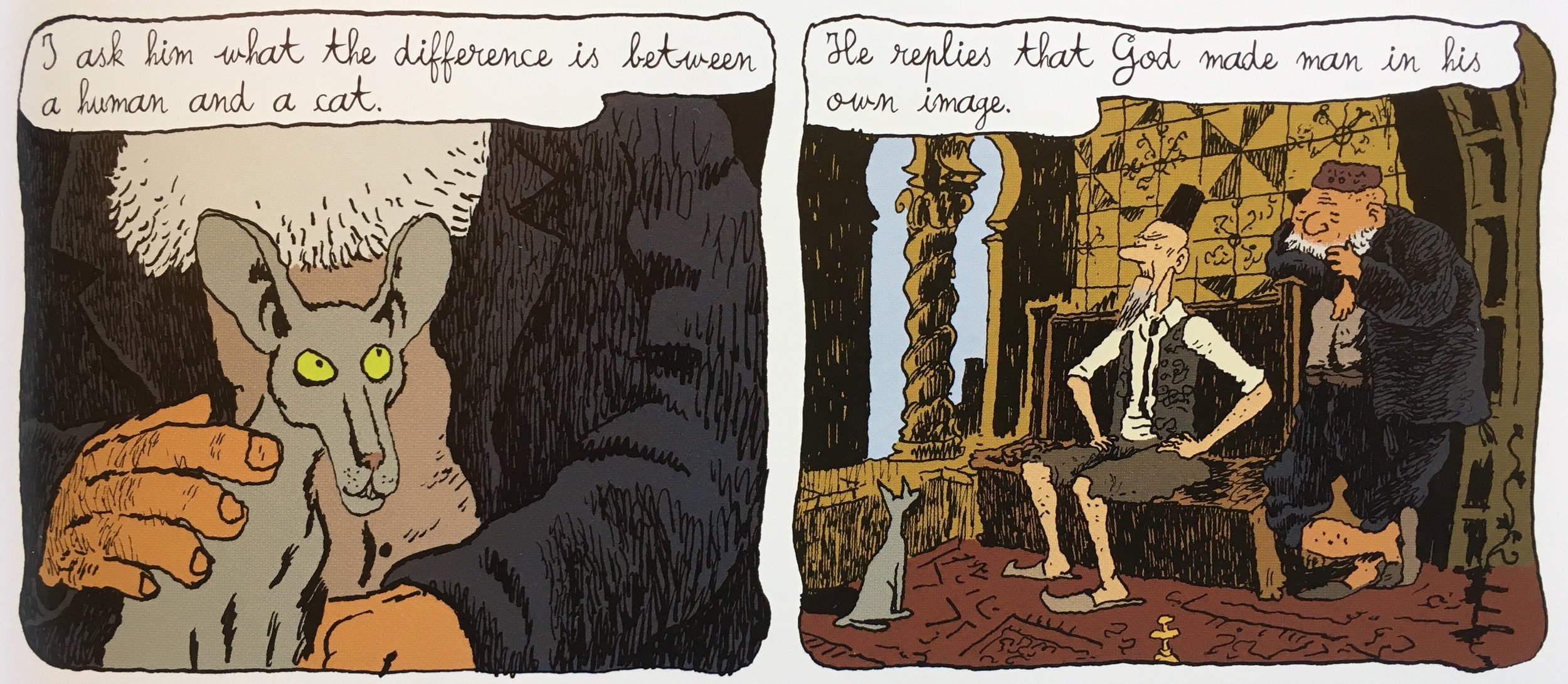
Joann Sfar, The Rabbi’s Cat, New York : Pantheon Books, 2005), 11/3-4 (image used with kind permission of artist)
R.R. Neis begins the AJR Animal Forum: To the extent that concerns about the human, species, animality, and reproduction criss-cross antiquity and the present, a species-informed approach to late antiquity not only allows us to hazard ways of thinking/being the non/human, it also can short-circuit rhetorical invocations of a “Judeo-Christian tradition” by falsifying cherished myths.
Read MoreJohn Martin - Joshua Commanding the Sun to Stand Still upon Gibeon (1816) National Gallery of Art, Washington, D.C.
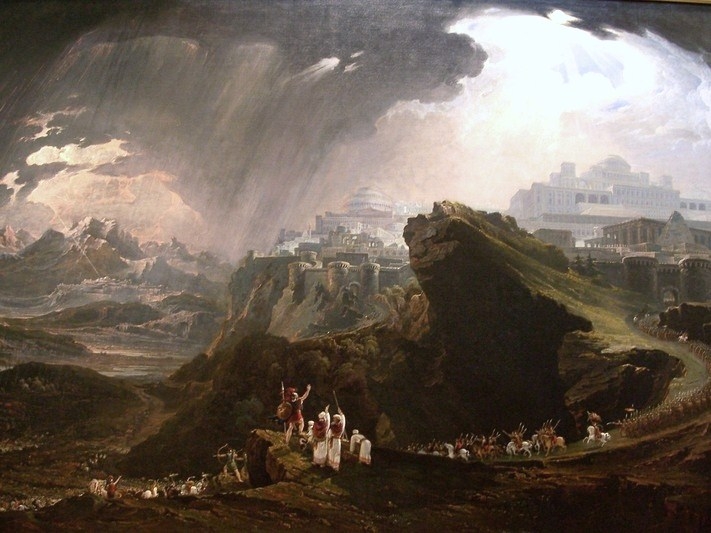
John Martin - Joshua Commanding the Sun to Stand Still upon Gibeon (1816) National Gallery of Art, Washington, D.C.
In my dissertation I explore such texts – what I call “personalistic nature texts” – and their potential contribution to contemporary environmental ethics. I argue that the biblical writers lived in a world populated with a wide variety of “persons,” only some of whom are human.
Read More
![Gherardo Starnina - Thebaid, ca. 1420, Tempera on wood (Wikimedia Commons) [Sometimes attributed to Fra Angelico]](https://images.squarespace-cdn.com/content/v1/5449167fe4b078c86b41f810/1534121418493-UZ3BXHO6ZL8M70BB8Q17/Angelico%2C_tebaide.jpg)
![Southwest Texas McAllen Border Fence, Rio Grande Valley [ Photographer: Donna Burton ]](https://images.squarespace-cdn.com/content/v1/5449167fe4b078c86b41f810/1533738883693-XLDP3WL924ZNTV91Z2EM/32860951106_bc66460846_z.jpg)