"What is intriguing about such statements as cited above—and one can list many similar cases with other authors—is that in them we witness how health, physiology, and anatomy are structured by means of social and cultural discursive formations. In this case, the discourse of slavery, which I have termed doulology,[iv] structures the dynamics between mental and gastric health. By their extension into the realm of the material psychē, these dynamics, in turn, shape the self. You are how you eat."
Read More
Dr. Lennart Lehmhaus shares a rabbinic case study in order to reflect upon the history of science and rabbinic texts: "A careful study of the discursive strategies and the embeddedness of such medical knowledge within their broader contexts of theology or religious law (Halakhah), allows one to highlight the differences in form and content in the variants of this narrative."
Read More
Dr. Caroline Wazer shares her work on Roman public health in the AJR forum on Ancient Medicine, concluding "that Roman ideas of what could and should be done in the interest of public health were more intimately connected to political climates than they were to the state of scientific knowledge, such as it was."
Read More
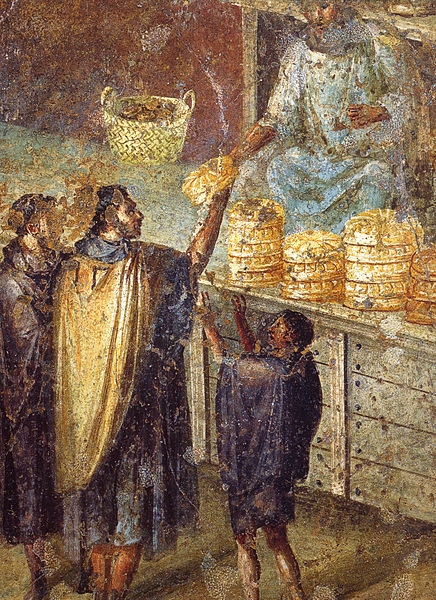
"When I asked what this emerging Christian food culture might have meant for the ordinary fourth century Christian, I found that it was not merely a trickle-down or oppositional model of lay vs. monastic or institutional piety. Rather, food helped early Christians negotiate among ideas across the spectrum of lived experience."
Read More
Carson Bay reviews Turning Proverbs towards Torah: an Analysis of 4Q525 by Elisa Uusimäki as part of our joint #Scrollsat70 celebration with @TWUDSSI.
Read More
Dr. Martha Himmelfarb with a retrospective piece on her work with the Book of the Watchers and ancient apocalypses: "Thus I no longer see the ascent apocalypses as an unbroken tradition emanating from the Book of the Watchers as I did in Ascent to Heaven."
Read More
"The appearance of the philosopher type in early Christian art was part and parcel of developments in late antique education, intellectual culture, and philosophical competition."
Read More
As part of our joint celebration of the #DSSat70 with @TWUDSSI, Josh Matson reviews “Exploring the Dead Sea Scrolls,” a collection of essays by Hanan Eshel.
Read More
Dr. Marc Herman applies Hayes' What's Divine About Divine Law to Islamic traditions.
Read More
Dr. Sarit Kattan Gribetz describes using an unexpected classroom balcony as a pedagogical tool.
Read More
Krista Dalton describes an Early Christianity lecture where students construct their own Harry Potter canons as a heuristic approach to Bible canons.
Read More
Dr. Jill Hicks-Keeton on "eating" a candle as a teaching moment.
Read More
Dr. Sarit Kattan Gribetz describes how to sensitize students to the sounds in ancient texts.
Read More
Dr. Rebecca Falcasantos with an alternative website-building term project.
Read More
"One criticism I have of Paul and the law scholarship (and Matthew and the law as well) is that extra-Jewish materials are only incorporated into a scholar’s research when such materials are believed to have influenced Paul’s thought. Put differently, extra-Jewish materials only count for Paul and the law scholars if we think Paul knew about them."
Read More
"The oblique nature of Paul’s references to the Abraham Narrative suggests that his implied readers, in fact, do know the basic contours of that story. Paul’s allusions to Genesis, therefore, must represent his efforts to get them to read or hear the Abraham Narrative very differently than they currently do."
Read More
"Description and Redescription – the classic interrelated activities that animate critical scholarship on religion. This roundtable affords the chance to examine two books that push the descriptive and redescriptive envelopes in their sectors of biblical studies."
Read More
"Ultimately, I believe that a full understanding of Paul combines both of these interpretations, though with one additional element. It is perhaps a function of my age that I am more cynical than our two authors, but I am inclined to agree that Paul’s offer of cosmic rule for gentiles of faith has the ring of a marketing ploy."
Read More
The SBL 2016 Pauline Epistles Review Panel including J. Albert Harrill, Christine Hayes, and Stephen Young with Matthew Thiessen and David Kaden responding.
Read More
"Reading Thiessen and Kaden synoptically thus fosters debate over how best to relate globalization studies and biblical studies."
Read More
![Fig.: The yellow indicates the vagal nerve running from the nervous system to the stomach (from Gray’s Anatomy, plate 793; Wikimedia commons [public domain]).](https://images.squarespace-cdn.com/content/v1/5449167fe4b078c86b41f810/1506362512031-CY0T2K6AEF0K345F70S4/Untitled.jpg)





![St. Paul by Lippo Memmi. On view at The Met Fifth Avenue in Gallery 625 [public domain]](https://images.squarespace-cdn.com/content/v1/5449167fe4b078c86b41f810/1499706892095-R1VREKNLN467FZ2E4BH2/DP295031.jpg)

!["The Conversion of St. Paul" Benozzo Gozzoli on view in The MET 5th Ave Gallery 603 [public domain].](https://images.squarespace-cdn.com/content/v1/5449167fe4b078c86b41f810/1499706383897-RN9T2V6L61GA2B7F6ID0/image-asset.jpeg)

