Sample webpage from Biblical Theology Spring 2017 semester.
Dr. Rebecca Falcasantos with an alternative website-building term project.
Read MoreSample webpage from Biblical Theology Spring 2017 semester.
Sample webpage from Biblical Theology Spring 2017 semester.
Dr. Rebecca Falcasantos with an alternative website-building term project.
Read MoreSt. Paul by Lippo Memmi. On view at The Met Fifth Avenue in Gallery 625 [public domain]
St. Paul by Lippo Memmi. On view at The Met Fifth Avenue in Gallery 625 [public domain]
"One criticism I have of Paul and the law scholarship (and Matthew and the law as well) is that extra-Jewish materials are only incorporated into a scholar’s research when such materials are believed to have influenced Paul’s thought. Put differently, extra-Jewish materials only count for Paul and the law scholars if we think Paul knew about them."
Read More"The oblique nature of Paul’s references to the Abraham Narrative suggests that his implied readers, in fact, do know the basic contours of that story. Paul’s allusions to Genesis, therefore, must represent his efforts to get them to read or hear the Abraham Narrative very differently than they currently do."
Read MoreThe Apostle Paul from St. Sophia of Kyiv (Wikimedia Commons)
The Apostle Paul from St. Sophia of Kyiv (Wikimedia Commons)
"Description and Redescription – the classic interrelated activities that animate critical scholarship on religion. This roundtable affords the chance to examine two books that push the descriptive and redescriptive envelopes in their sectors of biblical studies."
Read More"The Conversion of St. Paul" Benozzo Gozzoli on view in The MET 5th Ave Gallery 603 [public domain].
"The Conversion of St. Paul" Benozzo Gozzoli on view in The MET 5th Ave Gallery 603 [public domain].
"Ultimately, I believe that a full understanding of Paul combines both of these interpretations, though with one additional element. It is perhaps a function of my age that I am more cynical than our two authors, but I am inclined to agree that Paul’s offer of cosmic rule for gentiles of faith has the ring of a marketing ploy."
Read MoreThe SBL 2016 Pauline Epistles Review Panel including J. Albert Harrill, Christine Hayes, and Stephen Young with Matthew Thiessen and David Kaden responding.
Read MoreSaint Paul Writing his Epistles by Valentin de Boulogne (ca. 1618 - 1620) Wikimedia Commons
Saint Paul Writing his Epistles by Valentin de Boulogne (ca. 1618 - 1620) Wikimedia Commons
"Reading Thiessen and Kaden synoptically thus fosters debate over how best to relate globalization studies and biblical studies."
Read MoreSeasons sarcophagus with menorah in the clipeus. From the Vigna Randani catacombs, Rome. Musei Nazionale Romano, Terme di Diocleziano, Inv. No. 67611. (Photo: Author).
Seasons sarcophagus with menorah in the clipeus. From the Vigna Randani catacombs, Rome. Musei Nazionale Romano, Terme di Diocleziano, Inv. No. 67611. (Photo: Author).
"The use of sarcophagus burial by Jewish patrons was a highly variable mode of cultural interaction, representing an ongoing negotiation of Jewishness by different individuals from different communities in the context of enduring cultural exchange."
Read MoreLouis Armstrong, Library of Congress's Prints and Photographs division under the digital ID cph.3c27236.
Louis Armstrong, Library of Congress's Prints and Photographs division under the digital ID cph.3c27236.
Dr. Michael Swartz and Dr. Michael Satlow share a book that was an "unexpected influence" upon their academic work.
Read Moreff. 490V from the Trilingual Compendium of Texts (England, 14th c). Reproduced by kind permission of the Syndics of Cambridge University Library
ff. 490V from the Trilingual Compendium of Texts (England, 14th c). Reproduced by kind permission of the Syndics of Cambridge University Library
"The 'cerebral subject' might be the product of neuroscience and early modern philosophy, but its roots go much further back to antiquity, in the encounter between emergent Christian theories of the soul and entrenched medical understandings of the brain."
Read MoreAJR and @TWUDSSI’s online celebration of the seventieth anniversary of the Dead Sea Scrolls continues with a second forum devoted to the Aramaic Texts at Qumran with Jonathan Ben-Dov, Daniel Machiela, Devorah Dimant, Andrew Perrin, Henryk Drawnel, and Liora Goldman.
Read MoreHerod the Great entering Jerusalem. Flavius Josephus, The Judaic Antiquities, Illumination by Jean Fouquet, circa 1470-1475. Paris, BnF, Department of Manuscripts, NAF 21013, fol. 1V. (Book XV)
Herod the Great entering Jerusalem. Flavius Josephus, The Judaic Antiquities, Illumination by Jean Fouquet, circa 1470-1475. Paris, BnF, Department of Manuscripts, NAF 21013, fol. 1V. (Book XV)
Dr. Liora Goldman on priestly tradition, wisdom, and apocalypticism in the Qumran Aramaic texts.
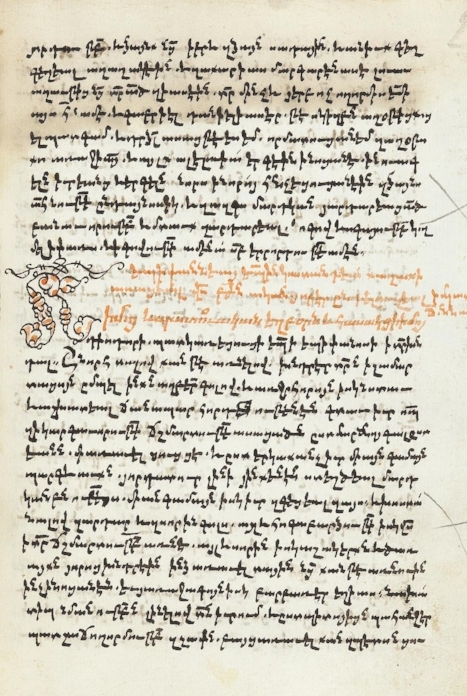
Read MoreArmenian manuscript at Tübingen (Ma XIII 93) - ff. 283r begins Epiphanius’ On the Gems in Aaron’s Breastplate
Armenian manuscript at Tübingen (Ma XIII 93) - ff. 283r begins Epiphanius’ On the Gems in Aaron’s Breastplate
"These extra-Greek survivals of Epiphanian texts underscore the important place of, at a minimum, an awareness of these other languages and the activity of translators, and at best, facility in reading and understanding one or more of these languages. They remind us likewise of how far, linguistically speaking at least, the name and fame of Epiphanius had spread, and much the same might be found for many other writers included in the pages of CPG. "
Read MorePallas Athena and Aegis surrounded by the moon's cycle. Vatican Museum.
Pallas Athena and Aegis surrounded by the moon's cycle. Vatican Museum.
Dr. Henryk Drawnel on cultural competition and critique between Mesopotamia and Qumran.
Read More"Mosaïque des échansons", du IIe siècle ap. J.-C., provenant de Dougga, au Musée national du Bardo (Tunisie) - Pascal Radigue (2001) - Wikimedia Commons
"Mosaïque des échansons", du IIe siècle ap. J.-C., provenant de Dougga, au Musée national du Bardo (Tunisie) - Pascal Radigue (2001) - Wikimedia Commons
"Ultimately, while Pliny clearly had an eye for prices, the actual numbers he provides aren’t especially useful. His discussions of price formation, however, do give us considerable insight into the way the market functioned in Pliny’s time as well as into Pliny’s ‘economic thought’. In various places Pliny mentions the role of supply and demand, changes in fashion, lying salesmen and other forms of fraud, as well as labor costs."
Read More"The New Jerusalem" number 80 from 'The Apocalypse of Angers', 1373-87 (tapestry) by Nicholas Bataille. Photograph by Kimon Berlin, CC BY-SA 2.5-2.0-1.0, via Wikimedia Commons
"The New Jerusalem" number 80 from 'The Apocalypse of Angers', 1373-87 (tapestry) by Nicholas Bataille. Photograph by Kimon Berlin, CC BY-SA 2.5-2.0-1.0, via Wikimedia Commons
Dr. Andrew Perrin on the origins of the apocalypse in ancient Judaism.
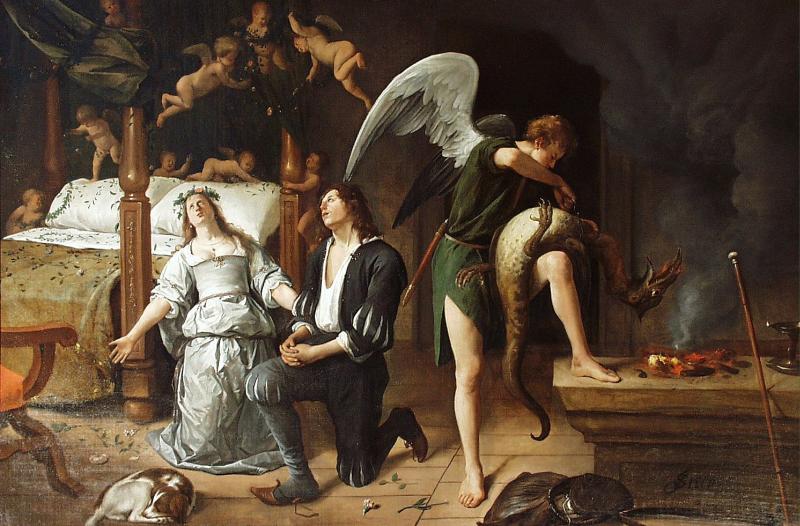
Read More"Tobias' and Sara's Wedding Night" by Jan Havicksz Steen ca. 1626 – 1679 in Museum Bredius
"Tobias' and Sara's Wedding Night" by Jan Havicksz Steen ca. 1626 – 1679 in Museum Bredius
Dr. Devorah Dimant on marriage, demons, burials, and halakhah in Tobit and Qumran.
Read MoreConrad Cichorius: "Die Reliefs der Traianssäule", Zweiter Tafelband: "Die Reliefs des Zweiten Dakischen Krieges", Tafeln 58-113, Verlag von Georg Reimer, Berlin 1900
Conrad Cichorius: "Die Reliefs der Traianssäule", Zweiter Tafelband: "Die Reliefs des Zweiten Dakischen Krieges", Tafeln 58-113, Verlag von Georg Reimer, Berlin 1900
"In the field of classical studies, the 2008 publication of The Cambridge Economic History of the Greco-Roman World has effectively ushered in a post-Finleyan era in the study of Greco-Roman economies by incorporating methods developed in the field of New Institutional Economics. In what follows, we examine representative samples of three emergent methodological trends: (1) the turn toward New Institutional Economics in studies of Greece and Rome; (2) Roland Boer’s model of the economy of ancient Israel; and (3) K. C. Hanson and Douglas Oakman’s social-scientific approach in New Testament studies."
Read More![St. Paul by Lippo Memmi. On view at The Met Fifth Avenue in Gallery 625 [public domain]](https://images.squarespace-cdn.com/content/v1/5449167fe4b078c86b41f810/1499706892095-R1VREKNLN467FZ2E4BH2/DP295031.jpg)

!["The Conversion of St. Paul" Benozzo Gozzoli on view in The MET 5th Ave Gallery 603 [public domain].](https://images.squarespace-cdn.com/content/v1/5449167fe4b078c86b41f810/1499706383897-RN9T2V6L61GA2B7F6ID0/image-asset.jpeg)