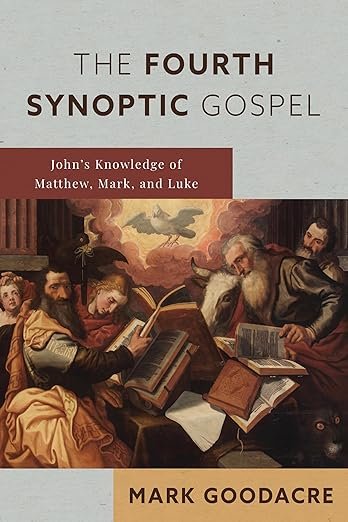
Mark Goodacre. The Fourth Synoptic Gospel: John’s Knowledge of Matthew, Mark, and Luke. Grand Rapids, MI: Wm. B. Eerdmans Publishing, 2025.
It has long been asserted within modern biblical scholarship that the author of the Gospel of John did not use the Synoptic Gospels when writing their story of the life of Jesus. This has become so ingrained in contemporary thought that when one talks about the canonical Gospels, they are nearly always categorized as two separate entities: the Synoptic Gospels and the Gospel of John. But in The Fourth Synoptic Gospel, Mark Goodacre challenges this perspective and attempts to demonstrate that the author of the fourth gospel was not only aware of the Synoptic Gospels but also used them in the writing of their gospel text.
In the opening chapter, Goodacre lays out his argument in a straightforward manner, stating that John knew and drew upon the Synoptic texts, not merely the traditions behind them (p. 6). He spends much of this chapter outlining the influence of the Two-Source Hypothesis for the Synoptic Gospels, a view which emphasizes the independence of the gospels of Matthew and Luke. As a result, it has been widely held that Matthew and Luke both used Mark as a source, but they did so independently of one another. The ever-present “source” of oral tradition has also lurked in the background of such discussions, leading many to categorize any similarities between John and the Synoptics as allusions to shared oral traditions rather than connections demonstrating literary dependence. Goodacre does not deny the presence of oral tradition but argues that it cannot be the only source of information for gospel authors and decries the tendency to overemphasize it and project nearly anything onto it (p. 14).
In Chapter Two, Goodacre begins the comparative approach he continues throughout the rest of the book. While there are some striking differences in narrative order between John and the Synoptics, such as Jesus’s “cleansing of the Temple” in Jerusalem, Goodacre demonstrates that most of the narrative structure is the same. He provides a list of 23 passages found in all four canonical gospels and shows that only three of them are found in different places in the Gospel of John. Such parallels are important because they “suggest a literary link rather than a link deriving from oral tradition” (p. 33). Beyond narrative order, several instances in John may demonstrate more direct literary connections. Goodacre provides numerous examples throughout the chapter, but the most powerful may be his comparison of a story found in Mark, Matthew, and John, of a woman who anoints Jesus with expensive perfume. There are specific phrases that appear in all three versions of this story such as, “For you will always have the poor with you” and the disciples lament that the valuable perfume was not sold and “the money given to the poor.” For Goodacre, this shared phrasing suggests literary connection. He ends this chapter by clarifying that he is not eliding the distinction between the Synoptic Gospels and John since there are critical differences between them. Instead, he suggests that there are valid arguments for acknowledging a literary relationship between the four texts (p. 43).
The third chapter examines how John appears to favor Matthean and Lukan redactions of Mark. Joseph of Arimathea, for instance, is simply referred to as a member of the Jewish council in Mark (Mark 15:43) but appears in Matthew as a disciple of Jesus (Matthew 27:57), a description which John chooses to replicate. John also mirrors Luke in important ways as well. For instance, John and Luke are the only gospels in which the name “Lazarus” appears, albeit in different contexts. The sisters Mary and Martha also only appear in John and Luke. These alone do not necessarily provide solid evidence that John knew and used Luke, so Goodacre looks to places where John appears to use Lukan redactions of Mark. A prominent example is in the Lukan and Johannine descriptions of Judas’s betrayal of Jesus in which “Satan entered into" Judas. Normally, John has a preference for διάβολος (devil), but in this one instance, he uses Σατανᾶς (Satan) just as Luke does, an odd choice that may be explained if we allow for the possibility that John knew and used Luke’s version of this story (p. 59).
On this foundation, Goodacre introduces the reader to several events or details from the Synoptics which are alluded to in John but are not narrated in the story. On one occasion, for instance, Jesus says, “Did I not choose you, the Twelve?” (John 6:70), but John only narrates the call of five disciples whereas the Synoptics provide complete lists of twelve. The arrest of John the Baptizer provides another example, where John says that the Baptizer had not yet been thrown in prison (John 3:24) but there is no narration of the arrest itself. The character of Lazarus, furthermore, is introduced as the brother of Mary and Martha, both of whom the reader is expected to know already (John 11:1-3). John also includes a reference to Mary wiping Jesus’s feet with her hair, even though that event does not occur in John until the following chapter. Such examples seem to demonstrate that John knew and was presupposing events from the Synoptics of which John’s audience may have also been aware. John was both presupposing events narrated in the Synoptic gospels and their audience’s knowledge of those events (p. 91). This may suggest the Synoptics were widely known by the time John was writing. The examples in this chapter stand as the most powerful part of Goodacre’s overall argument.
Next, Goodacre shows how John takes the Synoptic narratives and adds depth and vividness to them. One of the primary ways this is done is through the naming of unnamed Synoptic characters, such as Malchus, the slave of the High Priest, who is only named in John. John also takes what the Synoptics narrate and places it on the lips of the characters (p. 94). Whereas Mark narrates details about John the Baptizer, for example, the Fourth Gospel depicts John self-identifying as the “voice crying in the wilderness” (John 1:23). Goodacre posits that these literary choices reveal both a knowledge of Synoptic texts and the creativity to rework them in dramatic ways. This does not mean that the narrator of John is absent, but its narrative is driven more directly through the words and actions of the characters.
Any discussion of the Gospel of John would be remiss if it neglected the so-called “Beloved Disciple.” In Chapter Six, Goodacre attends to this character who has long been the focus of scholarly inquiry. He takes the Beloved Disciple to be a paragon of faithfulness in contrast to other members of Jesus’s inner circle who deny and betray him (p. 108-109). Goodacre suggests caution in linking John the son of Zebedee with the Beloved Disciple (p. 132) and differentiates between the Beloved Disciple and the “other disciple” who is mentioned occasionally throughout the Johannine Passion Narrative. But he does admit that the character is clearly someone close to Jesus who witnesses key moments and that readers of the Synoptics would have been more apt to see this figure as one of Jesus’s inner circle of disciples. Goodacre speculates that the Beloved Disciple is not named directly because they are someone already known by readers of the Synoptics, and thus, their anonymity in John creates an “idealized witness” who is nameless yet familiar (p. 133).
Goodacre then compares depictions of Jesus and his nature in John and the Synoptics. He explains that the Christology found in John is certainly of a different sort than that found in earlier gospels, but implies that it utilizes Synoptic imagery and themes (p. 135). While the Johannine Jesus is more clearly divine and ready to disclose his identity, the “I am” statements in John suggest Synoptic influence and invite the reader to consider the connection between these gospels (p. 150). In the concluding chapter, Goodacre reiterates his view that John knew and used the Synoptic gospels, asserting that the differences between these texts are often overstated without proper consideration of how they are similar. We are unable to fully enter the oral traditions behind the gospel texts, but when we place John alongside the Synoptics, we can more fully appreciate it (p. 163).
This relatively short book should be valuable to a broad audience, both within and beyond the academy. While it contains Greek versions of biblical verses throughout, it also provides English translations and comparative diagrams, which prove to be extremely helpful to Goodacre’s aims and to the reader. Goodacre’s arguments are exceptionally detailed and often compelling, but a few observations are worth making. First, confidence in the literary dependence between the Synoptics comes from frequent verbatim agreements, but many of the textual similarities Goodacre offers between John and the Synoptics hinge on similar themes or narrative structures, which may not necessarily demonstrate a literary relationship. Secondly, not all of the shared themes Goodacre presents are equally strong. In Chapter Two, for instance, he suggests that John possesses a messianic secret motif just as Mark does. To show this, he points to Jesus hiding from hostile crowds and avoiding groups who were in opposition to him, neither of which constitute an attempt on Jesus’s behalf to keep his messianic identity a secret. Moreover, as Goodacre later details, in John, Jesus is quite forthright about his identity. Thus, Goodacre’s arguments may leave some readers, including this one, feeling more skeptical that the similarities found between John and the Synoptics constitute a literary dependence. However, like Goodacre’s many other works, this book demonstrates other possibilities that may open new doors in our understanding of the Gospels and early Christianity. As such, it is a necessary read for this present moment in New Testament scholarship.
Tyler Blaine Wilson is a PhD student of religion at the University of Denver/Iliff School of Theology specializing in the Gospel of Mark, the historical Jesus, and Christian origins. He writes about history, religion, and meaningful books for popular audiences on his Substack page, Contingent History.